
A preschool classroom can tell you a lot about a child—if you know what to look for.
The child who watches quietly before joining a game, the one who is always asking “why?”, or the one who notices when a friend is upset are all displaying behaviours that can offer valuable insights into their development.
For preschool teachers, observation is therefore not just about keeping track of what a child does. It is about understanding how they think, communicate, interact and respond to the world around them.
Why Is Child Observation Important?
Children do not always have the words to tell us what they are thinking or feeling. Their behaviour often becomes an important way of understanding them.
Regular observation can help teachers identify a child’s strengths, interests and areas where they may need encouragement. It can also help teachers understand that two children displaying the same behaviour may have very different needs.
For example, a child who does not participate in group activities may simply be shy, may need more time to feel comfortable, or may be unsure about how to join the group. Observation over time can help a teacher understand the difference.
This makes observation a simple but powerful part of child development—one that, over time, builds a fuller picture of a child’s personality.
Free Download
Child Observation Checklist for Preschool Teachers
A ready-to-use checklist covering the 5 C’s: confidence, communication, creativity, collaboration and compassion. Short enough to use on a busy preschool day.
What Should Preschool Teachers Look For?
One useful way to observe a child’s development is through five everyday qualities.
- Confidence
Does the child try new things? Express their preferences? Speak up or ask for help? How do they respond when something doesn’t go as planned?
These behaviours can offer clues about their developing self confidence and willingness to participate.
- Communication
Can the child express what they want, explain an idea, listen to others and take part in conversations?
Observation here can highlight developing communication skills, vocabulary and expression.
- Creativity
Does the child come up with their own ideas? Find unusual solutions? Create stories during play? Ask questions or experiment?
These behaviours can reveal curiosity, imagination and flexible thinking.
- Collaboration
How does the child behave when playing with others? Can they share, take turns, listen to different ideas and work towards a common goal?
These are early indicators of social skills and cooperation.
- Compassion
Does the child notice when someone is upset? Offer help? Recognise how another person might be feeling?
Such moments can provide insight into developing empathy and emotional intelligence in young children.
Look Beyond the Obvious
Good observation also means noticing how children respond to different situations—not just what they do.
- When faced with a problem: Do they give up immediately, ask for help, or try another approach?
- When routines change: Can they adapt, or do they need additional reassurance?
- When meeting someone new: Do they approach, observe from a distance, or need encouragement?
- When speaking in a group: Do they confidently share their ideas, speak only when prompted, or avoid the situation altogether?
- When another child disagrees: Can they listen, negotiate and consider another perspective?
These small details can reveal the development of skills that don’t show up in a single observation—from adaptability and problem-solving to social awareness. Together with the five C’s above, they contribute to a fuller picture of a child’s personality and help them navigate relationships, challenges and new experiences as they grow.
Why Use an Observation Checklist?
Teachers make countless observations throughout the day. A checklist simply makes it easier to notice, record and reflect on them consistently.
Instead of relying only on memory or first impressions, teachers can use a structured checklist to:
- Track a child’s strengths and areas for growth
- Notice patterns in behaviour over time
- Identify skills that may need more opportunities for practice
- Understand individual differences between children
- Make parent-teacher conversations more meaningful
- Create more personalised learning experiences
For preschool teams and franchises, a common observation framework can also help teachers follow a consistent approach across classrooms.
A good rhythm is to observe informally every day, but sit down with the checklist once a week—during free play, circle time or transitions rather than a single formal sit-down. Over a term, these notes turn into real patterns worth sharing with parents, not just a snapshot of one good (or bad) day.
A Simple Child Observation Checklist to Get Started
The most useful observation checklist is one that is practical enough to use during a busy preschool day.
It should encourage teachers to look beyond academics and notice the small behaviours—confidence, communication, creativity, collaboration and compassion—that contribute to a child’s overall growth.
Get The Full Checklist
The most useful observation checklist is one that’s practical enough to use during a busy preschool day — encouraging teachers to look beyond academics and notice the small behaviours that contribute to a child’s overall growth.
We’ve created a ready-to-use Child Observation Checklist covering all 5 C’s. Here’s a look inside:
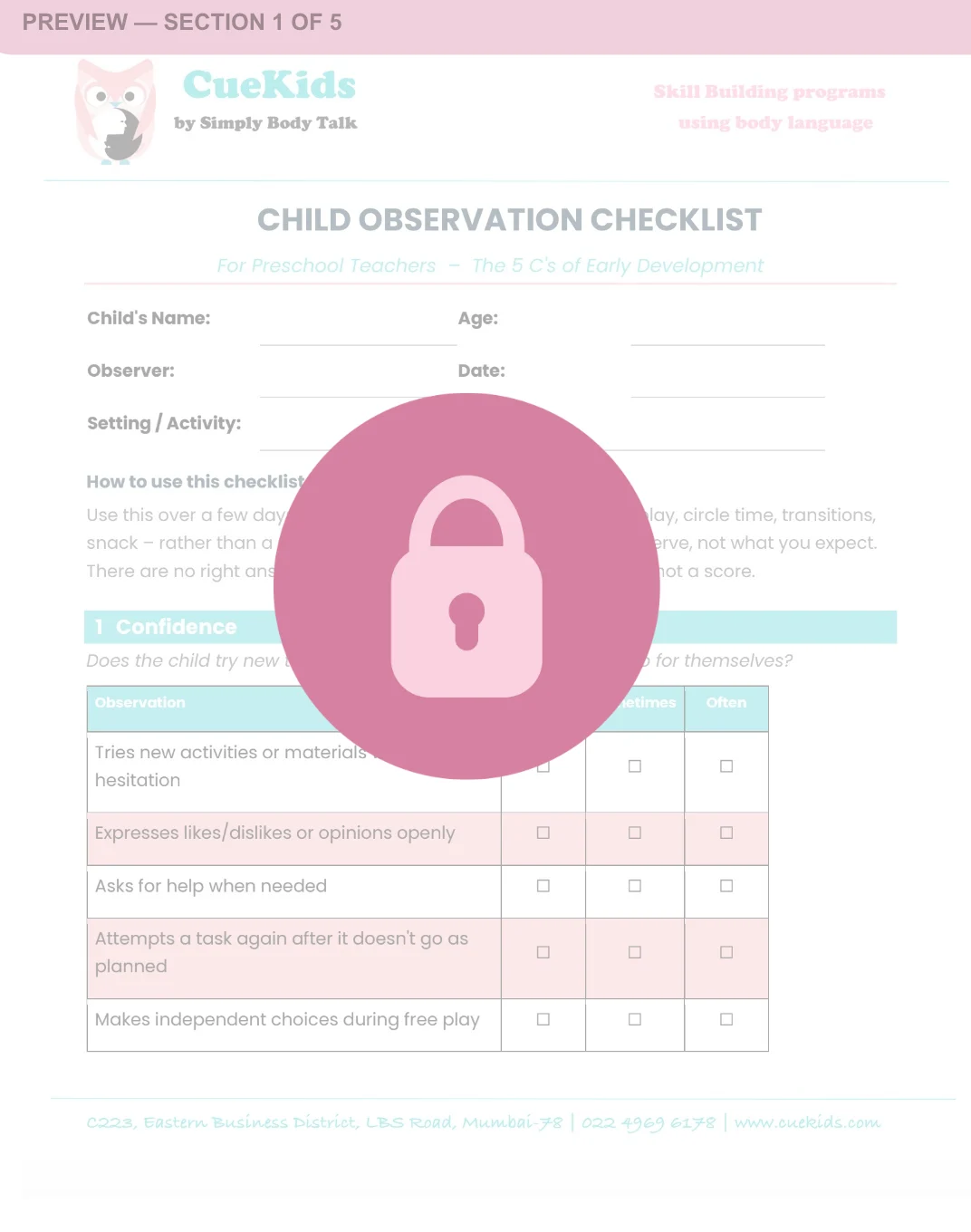
Download the full Child Observation Checklist
Frequently Asked Questions
Yes. Dated observations give you clear examples to share with parents instead of general impressions.
Look at how they communicate, play with others, handle emotions, move, and solve problems. The CueKids checklist lists these in one place.
Yes. You can download the CueKids checklist and print one copy per child.
Observe each child during play and daily routines, and record what you see on a checklist. Use the CueKids checklist to keep your notes consistent and dated.
A good checklist covers social, emotional, language, motor, and thinking skills in one simple sheet. CueKids’ free checklist is built for this and is ready to use in class.
CueKids offers a free Child Observation Checklist for preschool teachers. You can download it from this page.



Leave A Comment